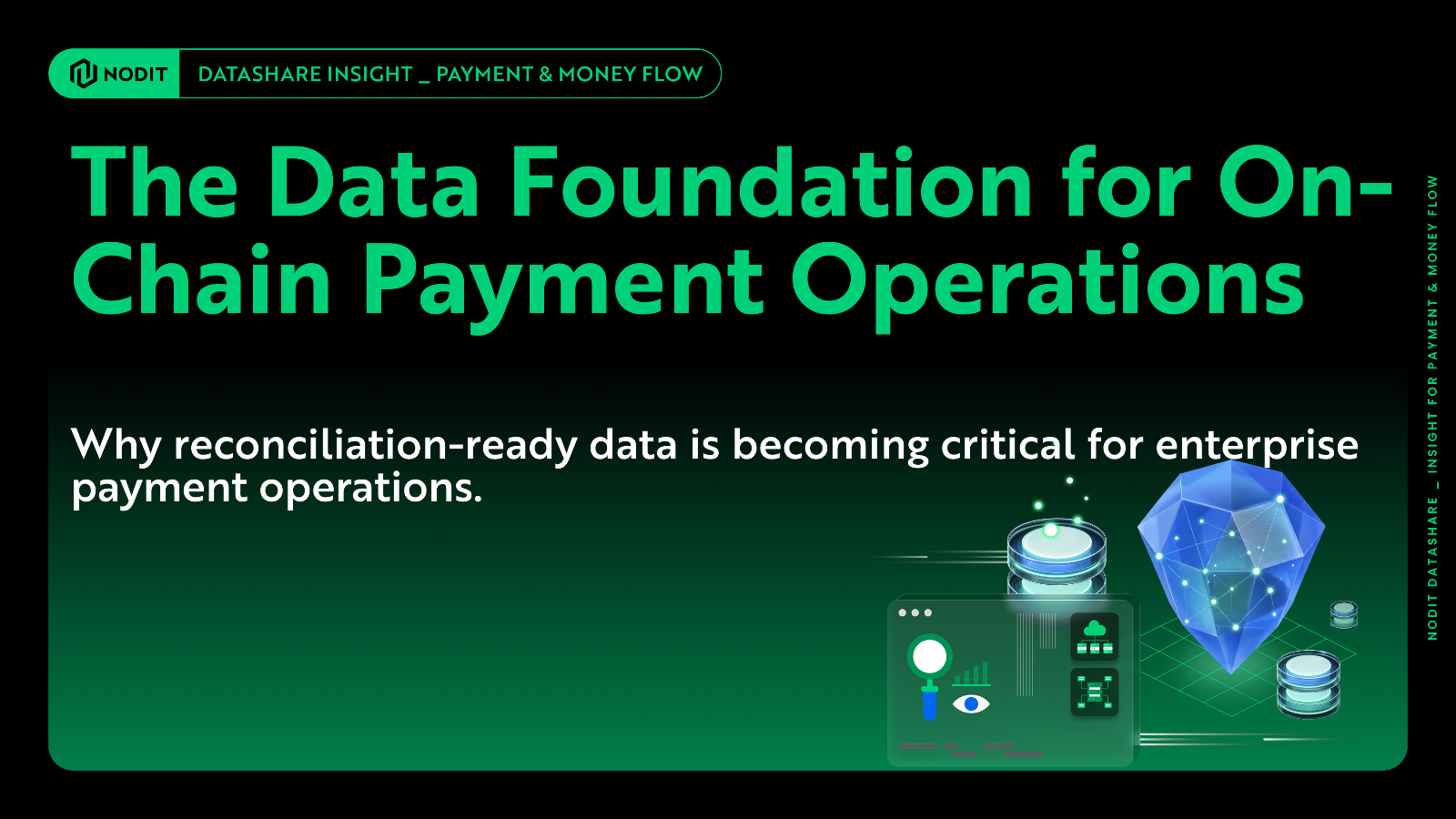
The Data Foundation for On-Chain Payment Operations
Published
2026.07.10
PDF Download
Fill in the required information to download the report.
In March 2026, monthly stablecoin settlement volume reached a scale comparable to the U.S. ACH network. Visa, Mastercard, and Stripe are all expanding their stablecoin settlement infrastructure.
But for payment operations teams, the critical questions are not about speed. They are about integration and control:
“How does this transaction enter our ledger?”
“Do on-chain balances reconcile with our books at end-of-day close?”
“Can we show customers a merchant name instead of a transaction hash?”
Payments are already fast. The real bottleneck is operational readiness. This article explores why card settlement and stablecoin settlement are structurally different—and why reconciliation-ready data is becoming critical for enterprise payment operations.
TL;DR:
Stablecoins are becoming part of mainstream payment infrastructure, but operational readiness—not transaction speed—is now the primary challenge.
On-chain settlement fundamentally changes reconciliation by introducing multi-chain data, blockchain-native identifiers, and continuous settlement.
Payment providers need validated, reconciliation-ready data—not raw blockchain data—to support financial operations, compliance, and customer experiences.
An independent data layer enables enterprises to integrate blockchain settlement into existing financial systems without building and maintaining blockchain data infrastructure.
![[Presentation Deck] CLAIR: From Traditional Compliance to AI-Powered Operations](https://cms-files.lambda256.io/contents/01M0ES2EVY18X0H05JBEKJJHES/a209ffa2-8040-4dd6-bd8a-3da7b2012891.png)